Designing an ensuite double vanity is often about balancing function, aesthetics, and technical constraints. A key element that can make or break the experience is the mirror and lighting configuration—especially when you want a center sconce between mirrors. Architects, decorators, and homeowners frequently wrestle with questions like: What mirror shape and size best suits a center-mounted sconce? How do you position sconces and mirrors for ideal task lighting? And what types of mirrors accommodate lighting upgrades without compromising visual appeal?
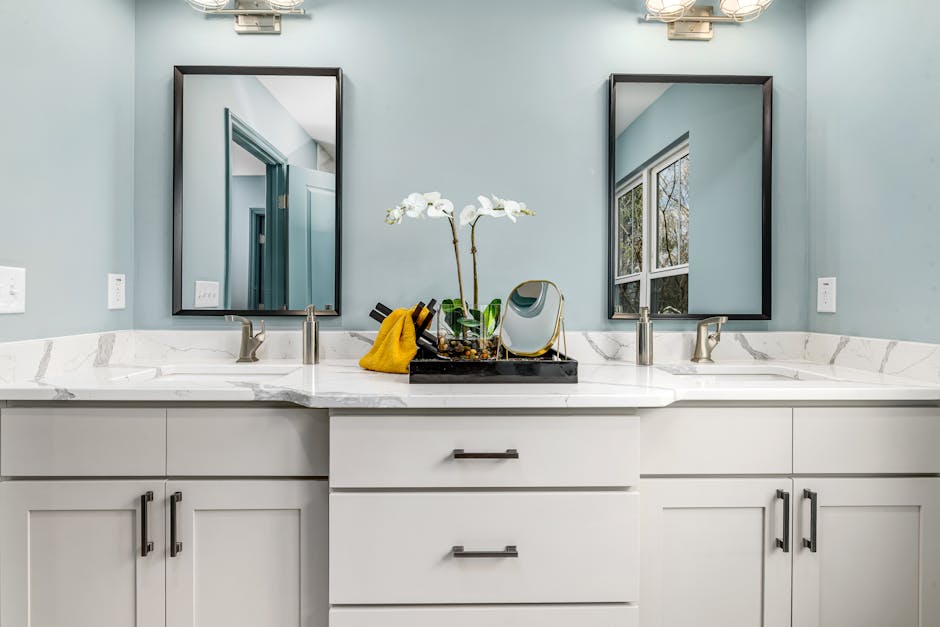
In this comprehensive guide, we’ll dive into the functional decisions behind mirror types, sizing and mounting considerations, and lighting placement strategies—drawing on best practices from the National Kitchen & Bath Association (NKBA), product insights from Golden Lighting and Lumens, plus real-world coordination tips involving glaziers and electricians.
Understanding Mirror Types for Double Vanities
Mirror choice is more than style; it influences usability and lighting effectiveness. When there’s a center sconce between mirrors on a double vanity, the interplay of shapes, mounting styles, and lighting integration becomes critical.

1. Mirror Shapes & Their Visual Impact
- Rectangular Mirrors: Classic and versatile, rectangular mirrors are the easiest to size and align with center lighting. They accommodate sconces neatly on the edges or between paired units. Square Mirrors: A bit more contemporary, but can be tricky if your sconces require additional clearance on top or sides. Round or Oval Mirrors: A growing trend in the 2020s, but challenging to pair side-by-side with a center sconce, as they eat into wall space that sconces rely on. The NKBA advises caution here for double vanities with a center light fixture, as it can look cluttered or overcrowded.
Verdict: Rectangular or slightly vertically elongated mirrors produce the best visual and functional results when paired with a center sconce between mirrors.
2. Storage Mirrors vs. Decorative Plates
Storage mirrors (medicine cabinets) provide utility at the cost of thickness and installation complexity. Flat plate glass mirrors offer a streamlined look but no hidden storage. Storage mirrors require extra depth clearance, impacting sconce placement.
- Storage Medicine Cabinets: Require careful coordination with the electrician and glazier to ensure frame depth doesn’t interfere with lighting placement. Best to avoid mounting center sconces on the wall surface that opens into cabinetry. Plate Glass Mirrors: Easier to template and install by glaziers, with flat mounting surfaces ideal for sconces. They are often the preferred choice for a clean double mirror pairing center strip design.
Verdict: Flat plate glass mirrors simplify coordination with center sconces, especially when working with hardwired LED lighting or when electricians need to add feeds for the sconces.
3. Mounting Types – Wall Hung vs. Vanity Mounted
Wall-mounted mirrors offer greater flexibility in height and ease of installation, particularly when coordinating with lighting. Vanity-mounted mirrors offer symmetry but often restrict valuable wall space needed for sconces.
Practical tip: Leaving 4–6 inches of wall space above the vanity backsplash is ideal for mounting both mirror and sconces comfortably without overcrowding.
4. Integrated Mirror Lighting vs. Separate Sconces
The temptation to integrate lighting inside the mirror (backlit or demister options) is growing. But if you’re specifically aiming for a center sconce, it implies separate fixture placement. This can optimize task lighting.
- Backlit Mirrors: Provide ambient light and reduce shadow on faces but rarely replace the need for task-focused sconces, especially in a double vanity layout. Demister Mirrors: Help reduce fog but add cost and complexity. No impact on lighting configuration for center sconces but worth specifying with glazier early to ensure wiring channels. Separate Hardwired LED Sconces: Golden Lighting and Lumens provide excellent options with modern dimmable LEDs offering warm, shadow-free task lighting perfectly suited for center mounting.
Verdict: Center sconces paired with standard plate glass mirrors represent a functional, proven approach—demister features are a smart add-on if the budget allows.
Sizing Rules Tied to Lighting Layout
Mirror dimensions should respond directly to the lighting layout, not the other way around. A common pitfall is choosing oversized mirrors that crowd out flanking sconces, limiting effective luminosity.
Element Recommended Dimension Notes Mirror Width (each) Approximately 1/3 to 1/2 the total vanity length minus sconce clearance Ensures balanced double mirror pairing center strip with sufficient wall space for the center sconce and side clearance. Center Strip (Gap Between Mirrors) ≥ 6 inches Allows enough space for a typical sconce fixture to mount between mirrors without edge crowding. Sconce Width 4–8 inches Consult Golden Lighting or Lumens specs for exact fixture dimensions. Avoid oversized sconces that overpower the mirror space. Mirror Height 36–42 inches from vanity countertop Provides ample viewing area for most users; NKBA guidelines support this range for task lighting zones.Example:
Given a 72-inch double vanity, two mirrors each around 24–26 inches wide separated by a 6-inch center gap leave sufficient space for a 6-inch wide sconce. The mirrors typically rise 36–40 inches high from the countertop, allowing sconces to be mounted with center height 60–66 inches above the floor for optimal illumination.
Placement Heights and Sconce Spacing
Want to know something interesting? proper vertical and horizontal placement of the center sconce is crucial for functional lighting and pleasing composition.
- Height: NKBA recommends sconce centers at 60 to 66 inches above the finished floor surface, or about 75–80 inches above the vanity countertop, depending on ceiling height and user needs. This avoids glare yet illuminates faces properly. Horizontal Spacing: A minimum 6-inch gap between mirror edges supports mounting a center sconce. This creates a double mirror pairing center strip that frames the fixture and avoids visual clutter. Clearance from Vanity: Maintain at least 4–6 inches between the mirror bottom and vanity backsplash to prevent moisture-related damage; ensure sconce wiring can run cleanly within wall cavities.
Coordination with the electrician ahead of time is vital. If hardwired LED sconces or mirrors with added feeds are part of the design, make sure the electrician locates switch feeds and junction boxes matching sconce and mirror placements precisely.
Task Lighting vs. Ambient Lighting
When considering mirror and sconce combinations, distinguish between task lighting and ambient lighting. Task lighting focuses on illuminating the face for makeup, shaving, and grooming, requiring a shadow-free, color-accurate light.
Task Lighting Characteristics
- Shadow-free, typically achieved using sconces on either side or a center sconce that directs light downward evenly. Color Rendering Index (CRI) ≥ 90 is recommended to faithfully represent skin tones and colors. LED bulbs around 2700K–3000K color temperature suit most residential bathrooms, creating a warm and flattering light.
Ambient Lighting Characteristics
- General illumination distributed across the room, often enhanced with backlit mirrors, ceiling fixtures, or recessed lighting. Supports overall relaxation and safety but does not replace focused task lighting near the mirror.
Verdict: A center sconce between mirrors on a double vanity serves best as focused task lighting. Backlit mirrors or other ambient sources should complement but not replace sconces.
Collaborating with Glaziers and Electricians
Successful bathroom lighting and mirror designs depend heavily on clear communication between your design team, glaziers, and electricians.
- Glazier Role: Responsible for templating and installing plate glass mirrors. Ensure they receive accurate mirror size and mounting heights and confirm the tolerance needed for sconce spacing. Mirrors with demisters or LED backlighting require careful wiring chase planning. Electrician Role: Must plan electrical feeds, switch placements, and junction boxes to align with player elements. Hardwired LED mirrors often need a dedicated power supply and controls, while sconces must be wired to dimmable circuits if dimmers are included.
Start early conversations with both trades to avoid costly mistakes like needing to relocate junction boxes or having incompatible mirror-backlighting wiring setups.
Summary: Mirror Type & Lighting Recommendations for a Center Sconce on a Double Vanity
Criteria Recommendation Notes Mirror Shape Rectangular plate glass mirrors Facilitates clear double mirror pairing center strip with center sconce Mirror Size Each mirror ~1/3 to 1/2 vanity length with 6-inch gap Avoids crowding sconces, balanced composition Sconce 4–8 inch wide LED hardwired sconce Offers shadow-free task lighting; Lumens and Golden Lighting are great sources Placement Height Center at 60–66” above floor (~75-80” above countertop) Optimal illumination without glare Lighting Type Separate sconces for task lighting plus ambient fixtures Demister options on mirrors recommended; do not rely on backlit mirrors alone Installation Coordination Early planning with electrician and glazier Ensures wiring and mounting points meet specs; reduces installation delaysFinal Thoughts
Mirror choice and lighting layout for an ensuite double vanity with a center sconce between mirrors requires marrying functional requirements with clean aesthetics. The National Kitchen & Bath Association (NKBA) guidelines offer a solid baseline, but the best results come from thoughtful coordination with lighting suppliers like Golden Lighting and Lumens, plus effective collaboration with glaziers and electricians to get the technical details right.
Always start with lighting design before settling on mirror width, leave appropriate clearance for sconces, and favor rectangular plate glass mirrors for that clean, balanced look. And don’t skimp on task lighting quality—it’s the daily workhorse in your vanity that should last decades.
architecturelab.netWith these principles in hand, your double mirror pairing with center strip sconce will be both a functional blessing and a sleek design statement.